
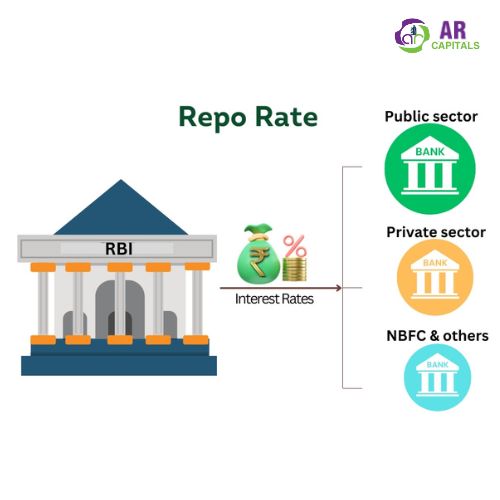
The repo rate (short for “repurchase rate”) is the interest rate at which the Reserve Bank of India (RBI) lends money to commercial banks in India against securities. This rate is a critical tool for monetary policy in India and is used to control inflation, manage liquidity, and stabilize the economy.
What is the Repo Rate?
- Definition: The repo rate is the rate at which the RBI lends short-term money to commercial banks against government securities.
- Mechanism: When banks face a shortfall of funds, they can borrow from the RBI at the repo rate by pledging government securities as collateral. This process is called a repurchase agreement.
Purpose of the Repo Rate:
Control Inflation: By adjusting the repo rate, the RBI can control inflation. A higher repo rate makes borrowing more expensive, reducing the money supply and slowing down inflation. Conversely, a lower repo rate makes borrowing cheaper, increasing the money supply and potentially boosting inflation.
Manage Liquidity: The repo rate helps manage liquidity in the banking system. By increasing the rate, the RBI can reduce liquidity, and by decreasing the rate, it can increase liquidity.
Economic Stability: The repo rate is used to influence economic activity. Lowering the rate can stimulate growth during economic downturns, while raising the rate can cool down an overheated economy.
Effects of Changes in the Repo Rate:
Borrowing Costs: Changes in the repo rate affect the borrowing costs for banks. Higher repo rates increase the cost of borrowing for banks, which typically pass on these costs to consumers and businesses in the form of higher interest rates on loans. Lower repo rates have the opposite effect.
Consumer Loans: The repo rate influences the interest rates on consumer loans, such as home loans, car loans, and personal loans. Higher repo rates lead to higher interest rates for consumers, and lower repo rates lead to lower interest rates.
Savings and Investments: The repo rate also affects the returns on savings and fixed-income investments. Higher repo rates can lead to higher returns on fixed deposits and savings accounts.
Economic Growth: By influencing borrowing costs, the repo rate indirectly affects economic growth. Lower repo rates can stimulate investment and consumption, leading to higher economic growth, while higher repo rates can slow down investment and consumption, reducing economic growth.
Examples of Repo Rate Adjustments
- During High Inflation: If inflation is high, the RBI may increase the repo rate to reduce the money supply and control inflation.
- During Economic Slowdown: If economic growth is slowing, the RBI may decrease the repo rate to make borrowing cheaper, stimulate spending and investment, and boost economic activity.
Repo Rate vs. Reverse Repo Rate
- Repo Rate: The rate at which the RBI lends money to commercial banks.
- Reverse Repo Rate: The rate at which the RBI borrows money from commercial banks. This is typically lower than the repo rate and is used to manage liquidity in the banking system.