
Indian Stock Market
1. Early Beginnings (1830–1875)
• 1830s: Trading in shares of banks and cotton mills began informally in Bombay (now Mumbai).
• 1850s–1860s: Trading activity increased during the American Civil War due to the cotton boom.
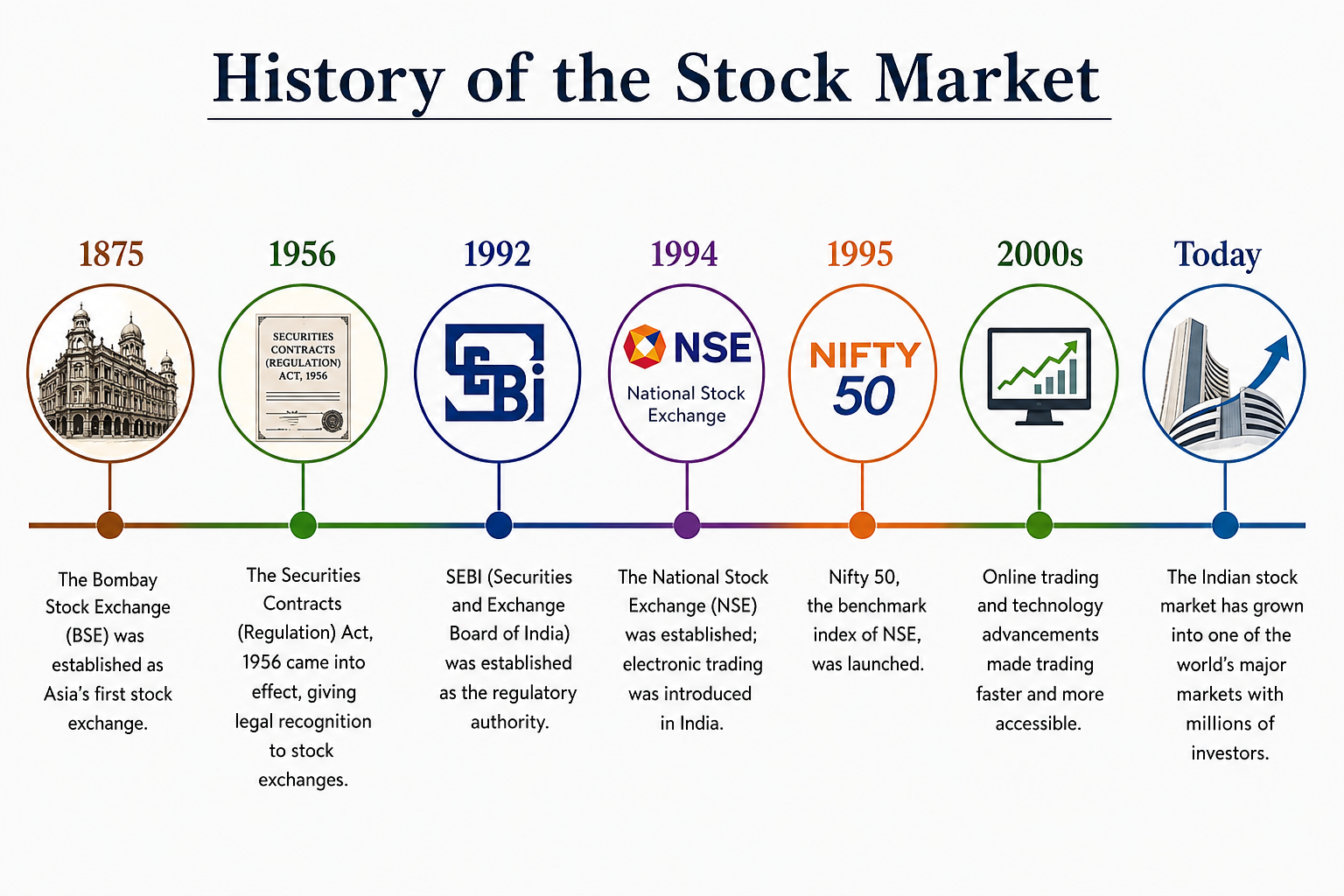
• 1875: Bombay Stock Exchange (BSE) was established as The Native Share & Stock Brokers’ Association, making it Asia’s oldest stock exchange.
2. Pre-Independence Growth (1875–1947)
- Stock trading expanded gradually across India.
- Regional stock exchanges were established in Ahmedabad, Calcutta, Madras and Delhi.
- Trading remained largely unregulated.
3. Post-Independence Era (1947–1991)
- 1956: Securities Contracts (Regulation) Act came into force.
- 1957: BSE became the first recognized stock exchange under the Act.
- Public and private companies increasingly raised capital through stock markets.
- Trading continued using the open outcry system.
4. Liberalization and Modernization (1991–2000)
- 1991: Economic liberalization opened India to private and foreign investment.
- 1992: SEBI became the statutory regulator.
- 1992: Harshad Mehta scam led to major reforms.
- 1992: NSE was incorporated.
- 1994: NSE introduced electronic screen-based trading.
- 1995: NIFTY 50 was launched.
5. Technology and Market Expansion (2000–2010)
- Online trading platforms became popular.
- 2000: Index derivatives introduced.
- 2001: Stock futures and options launched.
- NSDL and CDSL enabled dematerialization.
- 2008: Global Financial Crisis impacted Indian markets.
6. Modern Era (2010–Present)
- Retail participation increased through mobile trading apps.
- Growth of SIP investments in mutual funds.
- 2016: Insolvency and Bankruptcy Code (IBC) implemented.
- 2020: COVID-19 market crash followed by strong recovery.
- 2021–2024: Sensex and Nifty reached record highs.
Major Milestones
- 1875 – BSE established
- 1956 – Securities Contracts (Regulation) Act
- 1992 – SEBI became statutory regulator
- 1992 – NSE incorporated
- 1994 – Electronic trading
- 1995 – NIFTY 50 launched
- 1996 – Demat system introduced
- 2000 – Derivatives trading
- 2008 – Global Financial Crisis
- 2020 – COVID-19 crash & recovery
- 2024 – Sensex crossed 75,000
Important Reforms
- Establishment of SEBI
- Electronic trading system
- Dematerialization (Demat)
- T+1 settlement
- Algorithmic trading
- FII/FPI participation
- REITs & InvITs
- Insolvency and Bankruptcy Code (IBC)
Evolution of the Indian Stock Market
- Manual Trading → Electronic Trading → Demat Shares → Online Trading → Mobile Trading → AI & Algorithmic Trading.